
The Conversation Happening in Your Building Right Now
March 2026 - From Neurodiverse Inclusive Solutions
The Conversation Happening in Your Building Right Now
Most organizations approach neurodiversity as a future consideration. A policy to develop. A training to schedule. A conversation for later.
But neurodivergent people are already in your building. They always have been.
One in five people has a neurological difference — autism, ADHD, dyslexia, sensory processing differences, or some combination. Most of them have not disclosed. Many don't know yet themselves. And most of them are spending a significant portion of their workday compensating for environments that were not designed for how their brains actually function.
They are not underperforming. They are overworking — just not in ways that show up on a project timeline.
What That Looks Like in Practice
The employee who asks for clarification three times and is labeled "high maintenance." They are not difficult. They are working with instructions that contain more implied meaning than actual information.
The high performer who disappears after a promotion. The structure that made them successful just got removed. What looked like growth was actually the result of a very specific environment that no longer exists.
The staff member who does excellent work individually but struggles in open-plan meetings. Not because they lack skill. Because the sensory load of that room consumes processing capacity they would otherwise spend on the job.
These are not rare situations. They are the normal result of environments that were designed without accounting for how different nervous systems actually process information, manage transitions, and respond to unpredictability.
The Invisible Tax Your Environment Is Charging
Vague expectations that require interpretation before the work can start. Meetings with no advance agenda. Feedback delivered verbally with no written follow-up. Loud open workspaces with no quiet alternative. Evaluation criteria built around social style rather than output.
Each of these asks employees to compensate — to translate, to guess, to absorb — before they can do the actual job. For most neurodivergent employees, that compensation cost runs continuously. It does not shut off at lunch. It accumulates across the week and across years.
The result is not a bad attitude. It is burnout. And when someone burns out, they either leave or they stay and produce a fraction of what they were capable of.
Neither outcome is good for your organization.
The Download: Environmental Load Audit
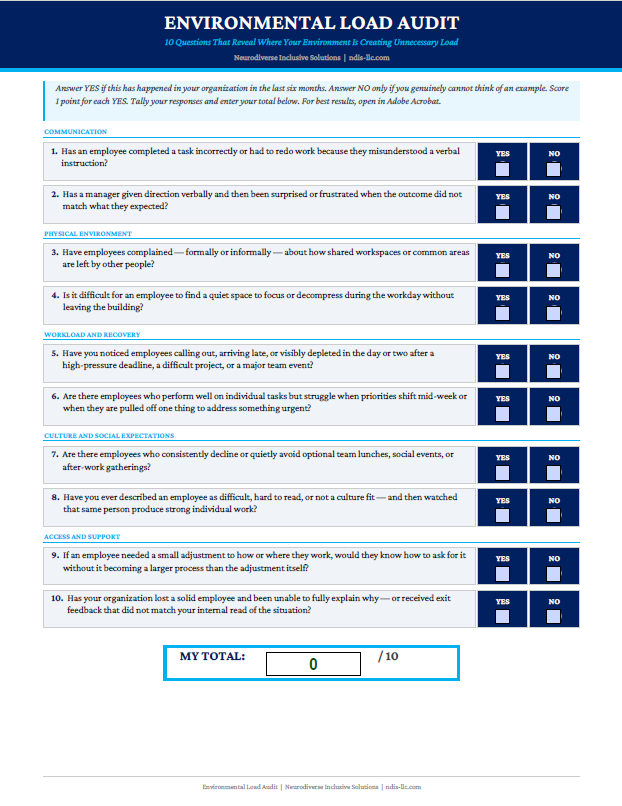
This month we are releasing the Environmental Load Audit — 10 questions that reveal where your environment is creating unnecessary load for the people inside it.
It does not require a diagnosis, a DEI consultant, or a new policy framework. It requires honest answers about how your organization actually operates.
Download the Environmental Load Audit: Click here for the PDF
Why This Matters Now
April is Autism Acceptance Month — three weeks away. It is the time of year when organizations post statements, add a graphic to their social profiles, and declare their commitment to inclusion.
Most of those commitments are not followed by anything structural.
We are not here for awareness. We are here for the next step.
If your organization wants to understand what your environment is actually asking of the people in it — and what practical changes would reduce that load — the audit is where to start.
What We Do
Neurodiverse Inclusive Solutions provides neurodivergent-informed workplace training, environmental consulting, and organizational strategy for employers who want practical results, not symbolic gestures.
Our work is built on two decades of corporate operations experience and the lived experience of navigating those systems as a late-diagnosed autistic professional. We understand how organizations actually function, and we know what realistic change looks like inside them.
For organizations ready to take a first step, our Workplace Toolkit gives HR teams and managers practical tools to reduce friction and improve clarity without overhauling everything at once.
We work with employers, nonprofits, community organizations, and service providers across the Salem region and beyond.
Schedule a free 30-minute consultation: Click here to schedule
Email: dandickinson@ndis-llc.com
Meet Our Founder: Dan Dickinson Sr.
Dan Dickinson Sr. is a late-diagnosed autistic professional, corporate veteran, and founder of Neurodiverse Inclusive Solutions. With over two decades of experience in operations, change management, and workforce development, Dan builds neurodivergent-informed systems that help organizations create environments where people don't have to sacrifice their health to do their job.
His work is grounded in lived experience — not as a backdrop, but as the foundation. Dan left a corporate career in enterprise operations to build what didn't exist for his own family: practical, structured support for neurodivergent people in workplaces and communities. He works with employers, nonprofits, and service providers across the Salem region to close the gap between awareness and structural change.