
Bicycles, Motorcycles & Mopeds
Bicycles, motorcycles, and mopeds are harder to see and more vulnerable in a crash. A few specific rules keep everyone safe.
Bicycles
People riding bicycles are more difficult to see than other vehicles. They can be hidden in your blind spot and easily missed. They often react differently to road conditions than motor vehicle drivers, such as potholes, glass, litter, storm grates, railroad tracks, and opened doors of parked vehicles. Any of these could cause a person riding a bicycle to move into your path or slow down. Give them plenty of room.
When you approach a person riding a bicycle, be alert and prepare to slow down if needed. You may not be able to predict their intentions.
Rules for Sharing the Road with Bicycles
- Do not drive or park in a bike lane. You may cross one when turning or entering/leaving an alley, driveway, or private road.
- Do not move into or travel in a bike lane in preparation for a turn.
- You must yield to people riding bicycles in a bike lane or on a sidewalk before turning across it.
- You must yield to people riding bicycles at intersections, the same as you would other vehicles.
- At speeds greater than 35 mph, you may only pass a bicyclist in your lane when safe, leaving enough distance to prevent contact if they were to fall.
- The same passing rules apply to bicycles as other vehicles. If you cannot pass safely, slow down and stay behind until it is safe.
- Operators of motorized wheelchairs, scooters, and personal assistive mobility devices may use bike lanes and paths. You must yield to them as you would a bicyclist.
Bike Boxes and Sharrows
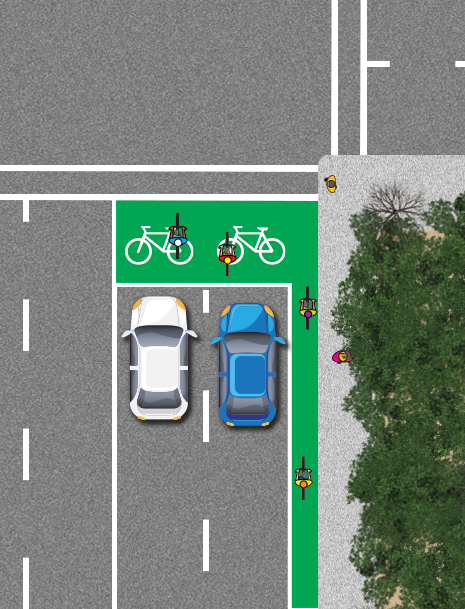
Bike Boxes: A green painted box on the road with a white bicycle symbol; approach and departure bike lanes may also be green. You must stop for a signal behind the bike box, not in it. People riding bicycles will move into the box ahead of you. No turns are allowed at these intersections on red. If turning right on green, signal and yield to bicyclists on the right.
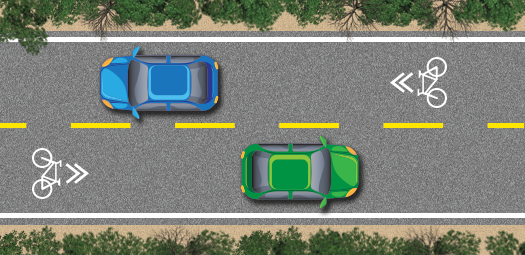
Sharrow: Indicates a shared lane where people riding bicycles may be present, shown by two chevrons above a bicycle symbol painted on the road.
Motorcycles and Mopeds
A motorcycle or moped is more difficult to see than other vehicles and can be hidden in your blind spot. It can also be difficult to judge how far away one is or how fast it is going. You must yield to an oncoming motorcycle just as you would any other vehicle; it is safest to wait until it passes before turning. When following, allow more distance than you would for a car.
It is against the law to share a lane with a motorcycle or moped. When passing, you must allow them a full lane. Weather and road conditions, like strong winds, gravel, debris, or grooved pavement, affect motorcycles and mopeds more than other vehicles. Increase your following distance.
Bicycles, Motorcycles & Mopeds: Knowledge Check
5 questions. Answer them all, then check your answers. You can change your answers and try again as many times as you want.
1. At speeds greater than 35 mph, when passing a person riding a bicycle you must:
2. A bike box is used for:
3. It is legal to drive or park in a bike lane:
4. When passing a motorcycle or moped, you must:
5. A sharrow marking on the road means: