
Large Vehicles, Buses & Other Vehicles
Large vehicles, buses, and other special vehicles on the road each come with their own blind spots and rules for safe sharing.
Large Vehicles
Large vehicles such as recreational vehicles, vehicles towing trailers, trucks, and commercial buses take longer to accelerate and require more room to maneuver. They take about three times the distance to stop compared to smaller vehicles at the same speed.
Blind Spots and Passing
Side blind spots: Large vehicles have larger blind spots on both sides than smaller vehicles. If you can't see the driver in their side mirror, they can't see you.
Rear blind spot: Large vehicles have a deep blind spot directly behind them. Following too closely also severely reduces your own view. Do not pull up too close behind a stopped large vehicle, since it may roll back slightly when starting forward.
Unsafe passing: It takes longer to pass a large vehicle. Complete your pass as quickly as possible and don't linger alongside it, since staying in its blind spot too long is dangerous. Look for the entire front of the vehicle in your rearview mirror before pulling back in front. If there is water on the road, spray from a large vehicle will seriously reduce your vision; keep as far away as you can while staying in your lane.
Turns, Backing, and Hills
Turns: Large vehicles often cannot see vehicles directly behind or beside them while turning. Observe their turn signals. Do not cut in between a large vehicle and the curb or shoulder; they may need to swing wide or use more than one lane. When you see a large vehicle turning, do not crowd the intersection; let it complete the turn.
Backing: A large vehicle backing up may need to block the street to maneuver. Never cross behind a large vehicle that is preparing to back up or is backing.
Hills: Large vehicles cannot maintain speed climbing hills and must go slowly downhill to stay in control. Smoking wheels or high speed downhill can signal brake loss. If you see this, leave more space and do not pass.
Pilot Vehicles
Pilot vehicles are specially marked vehicles that lead or follow a vehicle carrying an especially large load.
- If you see a pilot vehicle in oncoming traffic, reduce your speed and move as far right as possible while staying in your lane.
- If you are following a pilot vehicle, increase your following distance.
- Be cautious when passing a pilot vehicle or the large load it is escorting.
School, Worship, and Transit Buses
School Buses: School buses have flashing amber and red lights near the top, front and rear, and may have a stop arm that extends when red lights flash.
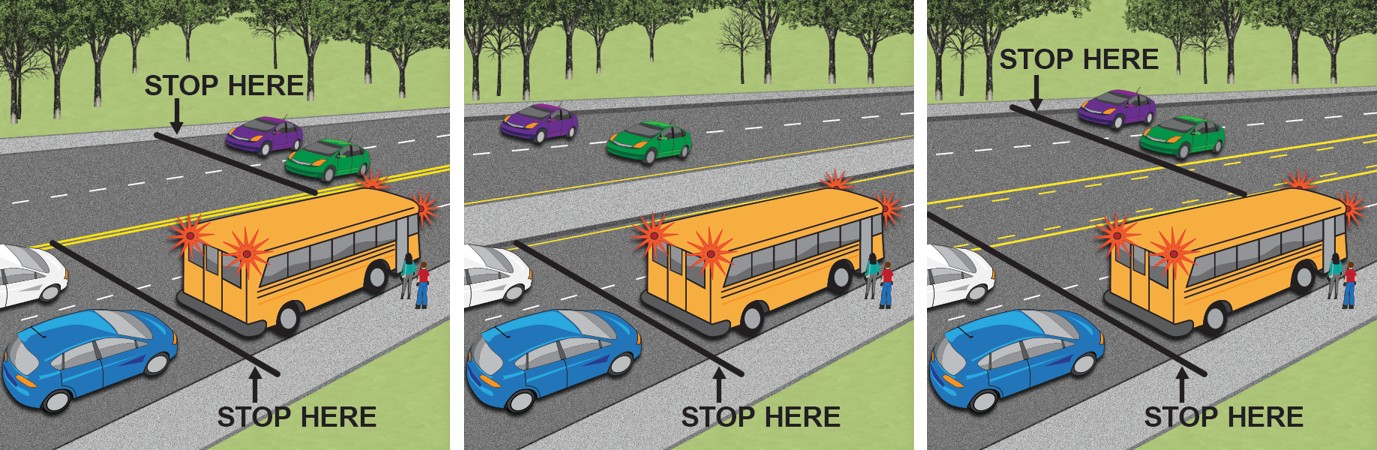
Flashing amber lights warn that the bus is about to stop; prepare to stop. When red lights flash, stop before reaching the bus and remain stopped until the driver turns them off. On a divided highway with an unpaved median or barrier, you must only stop if you are on the same side as the bus. A painted median strip or turn lane does not create separate roads, so in that case, all lanes must stop.
Place of Worship or Worker Buses: These may use flashing amber and red lights. Treat them the same as a school bus.
Public Transit Buses: These often pull to a curb to load or unload. Vehicles approaching from the rear must yield when a bus driver signals to re-enter traffic and an electric "yield" sign is flashing on the back of the bus.
Other Vehicles
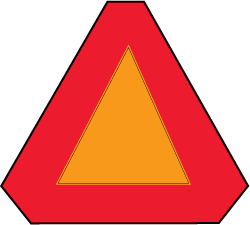
Slow Moving Vehicles: Farm equipment and similar vehicles must display a reflective red-and-orange Slow Moving Vehicle emblem. Be prepared to slow down or adjust your position when you see it.
Over-Length and Over-Width Loads: A red flag at least 12 inches square must mark any load extending 4 feet or more beyond the rear of a vehicle (replaced by a visible red light in low visibility). Passenger vehicle loads cannot extend beyond the left fenders, more than 6 inches beyond the right fenders, or more than 4 feet in front of the vehicle.
Funeral Processions: These are exempt from certain rules, and may enter intersections without stopping or obeying traffic control devices. Other vehicles must yield to funeral processions. It is against the law to join or drive between vehicles in a procession unless you are part of it.
Large Vehicles, Buses & Other Vehicles: Knowledge Check
5 questions. Answer them all, then check your answers. You can change your answers and try again as many times as you want.
1. Large vehicles take about how much longer to stop than smaller vehicles at the same speed?
2. If you can't see the driver of a large vehicle in their side mirror, that means:
3. When a large vehicle is backing up, you should:
4. When red lights are flashing on a school bus on a road with a painted median or turn lane (not a physical barrier), which traffic must stop?
5. A vehicle displaying a Slow Moving Vehicle emblem is usually: