
Railroad Crossings, Light Rail & Street Cars
Trains and streetcars can't stop quickly or swerve out of the way. These rules exist because the responsibility for avoiding a collision falls entirely on the driver.
Railroad Crossing Signs
Signs and signals mark railroad crossings. When you see them, look, listen, and slow down, since you may have to stop. A railroad advance sign warns that a crossing is ahead.
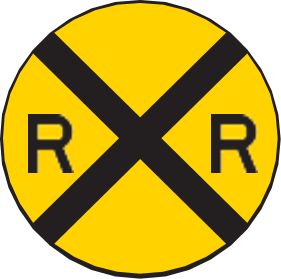
A railroad crossbuck assembly includes a yield or stop sign. Obey the posted sign. If there is more than one track, a sign below the crossbuck shows the number of tracks.
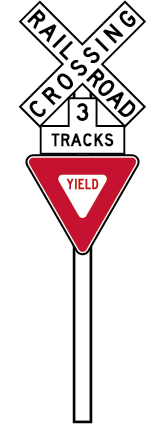
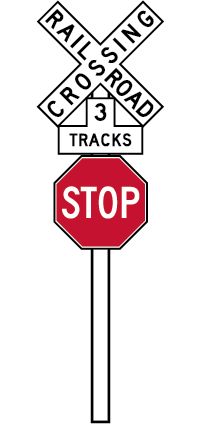
A crossing signal system includes flashing red lights, and may have a gate with red flashing lights activated when a train is nearby. Railroad crossings also have pavement markings with a large "X" and the letters "RR." Only cross the tracks if you are sure you can completely clear the crossing.
Remember These Rules
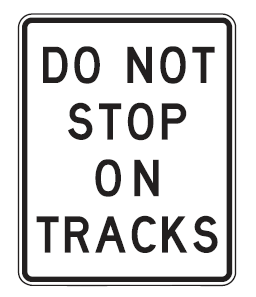
- Never stop on the tracks.
- Never try to beat a train at a crossing.
- The train you see is closer than it seems.
- Trains cannot stop quickly.
- All school buses, hazmat vehicles, and some school activity vehicles must stop at railroad tracks. Be prepared to stop when following these vehicles.
- One train may be blocking the view of another one.
Stop Before Railroad Tracks When:
- Flashing red lights are activated.
- An approaching train is clearly visible, or is so close that crossing would be hazardous.
- A stop sign is posted, even if you do not see a train coming.
- A flagger signals you to stop.
It is against the law, and extremely dangerous, to drive around or under a crossing gate while it is down or being raised or lowered. After stopping, do not start across the tracks until you are sure you can do so safely. At crossings with multiple tracks, look carefully for a second train coming from either direction.
If a Vehicle Is Stuck on the Tracks
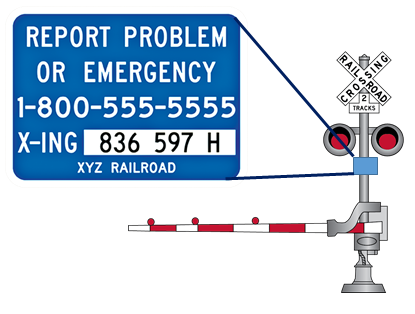
- Get out of the vehicle.
- Get away from the tracks, even if you do not see a train.
- If it's safe, look for an Emergency Notification System (ENS) sign on a post at the crossing to notify the railroad of the obstruction, so they can alert incoming trains.
- If a train approaches, move at a 45 degree angle from the tracks in the direction the train is coming from, so you are not hit by debris.
Traveling Around Streetcars and Light Rail Trains
Streetcars and light rail trains are electric transit vehicles that run on tracks embedded in the streets. They sometimes travel in the same lanes as cars and make frequent stops to pick up and drop off passengers, much like buses. Because they share the road with cars, drivers need to be extra careful around them.
Rules for Sharing the Road with Streetcars
Let streetcars and trains go first: Do not try to pass one unless it is safe to do so. If a streetcar or train stops to pick up or drop off people, stay behind it until it moves again or the people are safely away.
Do not block tracks: Stay behind any stop line before crossing tracks at an intersection. Never park on streetcar or train tracks; park behind the solid white line separating the parking area from the track, or as close to the curb as possible if there is no line. Always check for approaching streetcars or trains before opening vehicle doors, and make sure your parked car is clear of the tracks.
Watch for pedestrians: Look out for people getting on or off; passengers will run across lanes to catch the streetcar or train. Follow pedestrian signals and let people cross safely.
Check before changing lanes: Streetcars and trains cannot stop quickly. Avoid braking suddenly or making unpredictable moves in front of or around them. If you do make contact with a streetcar or train, wait for the operator or police to give you direction.
Railroad Crossings, Light Rail & Street Cars: Knowledge Check
5 questions. Answer them all, then check your answers. You can change your answers and try again as many times as you want.
1. If there is no stop line at a railroad crossing, you must stop at least how far from the nearest rail?
2. If a gate at a railroad crossing is down or is being raised or lowered, you should:
3. If your vehicle becomes stuck on railroad tracks, your first step should be to:
4. When a streetcar or train stops to pick up or drop off passengers, you should:
5. Where should you park near streetcar or light rail tracks?