
Space Cushion, Curves & Changing Lanes
Keeping space around your vehicle, ahead, to the sides, and behind, gives you and other drivers time to react safely.
Maintaining a Space Cushion
When a driver makes an unexpected or quick movement, other drivers need time to react. The only way you can be sure you have enough time to react is by leaving plenty of space between your vehicle and the vehicles around you. That space becomes a "space cushion." You should try to keep a cushion of space ahead, to each side, and behind you.
Following Distance
The speed at which you drive determines how much time you have to act or react, and how long it takes to stop. The higher your speed, the less time you have to spot hazards, judge the speed of other traffic, and react to conditions.
To check your following distance: Watch for when the vehicle ahead passes something like a sign or pole. Count the seconds it takes you to reach the same spot. If you pass the mark before counting at least two seconds, you are following too closely. Increase your space and check again.
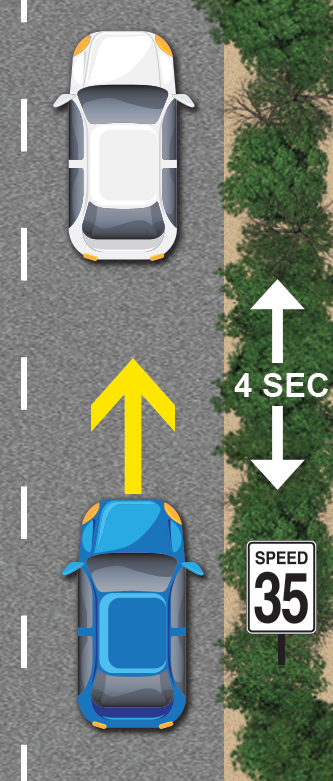
Increase your following distance when:
- The road is wet or slippery.
- A driver behind you wants to pass.
- You are following a bicycle or motorcycle.
- You are following a large vehicle that may not be able to see you.
- You have a heavy load or are pulling a trailer.
- It is hard to see, due to weather or darkness.
- You are stopped on a hill.
- You are learning to drive.
- You are approaching or in a work zone.
Side Space Cushion
A space cushion to the side gives you room to react defensively to sudden moves toward your lane. You should:
- Be cautious driving alongside other vehicles on multi-lane streets. If possible, drop back or move ahead of the other vehicle.
- Keep as much space as possible between your vehicle and oncoming vehicles. It is safest to drive in the center of your lane.
- Make room for vehicles entering freeways by moving over a lane if possible.
- Keep extra space between your vehicle and parked cars. A door may open, or someone may step out.
Space Cushion Behind and Backing Up
Help keep the driver behind you at a safe distance by keeping a steady speed and signaling in advance when you slow down or stop. If a vehicle behind you is following too closely, move over to the right if you can, or slowly reduce your speed. Never brake hard to discourage tailgating, since you could get hit from behind.
Backing up: A common mistake is failing to look both ways behind you. Mirrors do not give you a full view. Turn your body and head to look out through the rear window, check both sides for pedestrians and approaching traffic, then back up slowly.
Stopping Distances
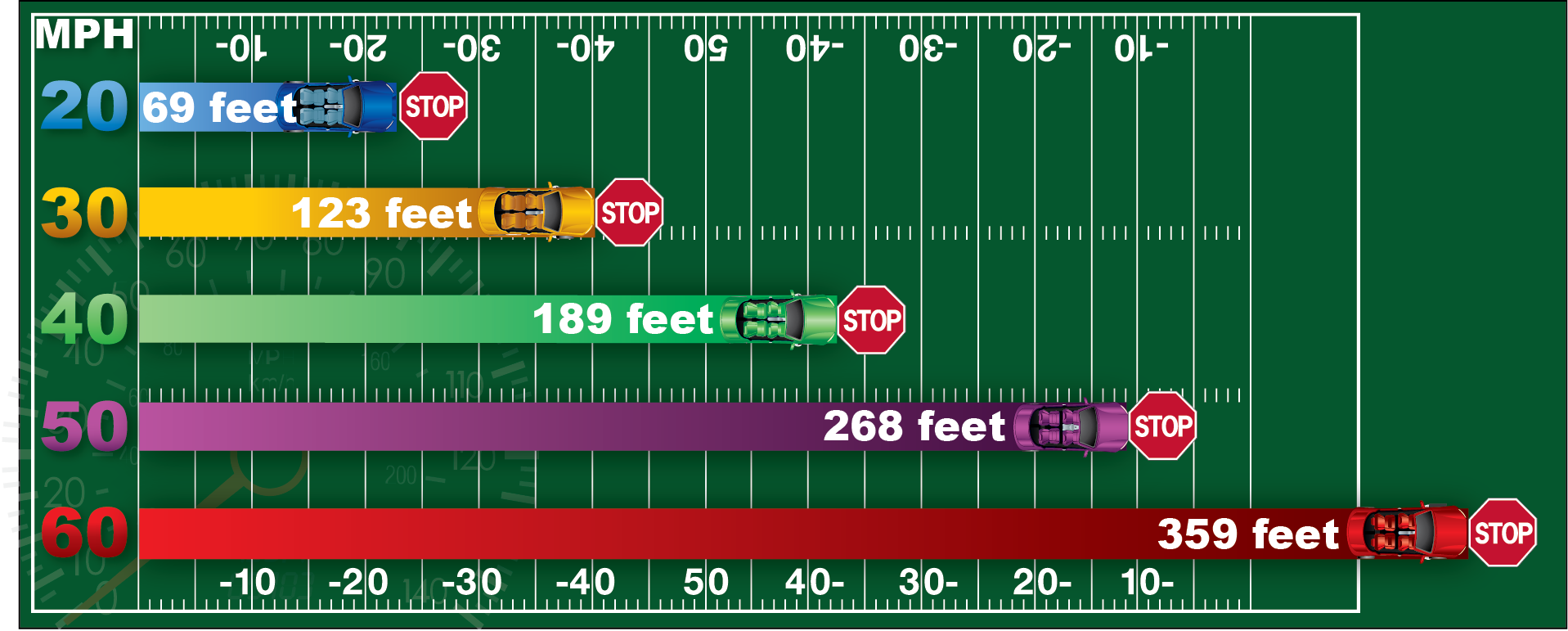
Stopping distance depends on road and weather conditions, the weight of your vehicle, your reaction time, and your vehicle's braking ability. The faster you drive, the greater your stopping distance, even in ideal conditions. Stopping takes longer than you think: at 60 mph, the distance from recognizing a hazard to coming to a full stop is greater than the length of a football field.
Looking Ahead
Scan ahead for trouble spots as far as you can see to avoid the need for last-minute moves. Scanning means taking in the entire scene, including the sides of the road, to spot pedestrians, hazards, vehicles that may enter your path, or route signs. Look for clues that a driver ahead may slow or stop, such as a bicyclist or pedestrian on the road ahead, brake lights, or blinking turn signals.
Curves
Slow down before you enter a curve. Use the speed shown below a curve sign as a guide, if posted. Look through the curve to where you want to go, then check the lane position of approaching vehicles. Stay to the right of the center line and in the middle of your lane. Be alert for bicyclists, pedestrians, or slow-moving vehicles hidden around the curve. As you come out of a curve, increase your speed gradually.
Changing Lanes
Your "blind spot" is the area around your vehicle that you cannot see from the driver's seat, even using your mirrors. Avoid driving in another driver's blind spot when possible.
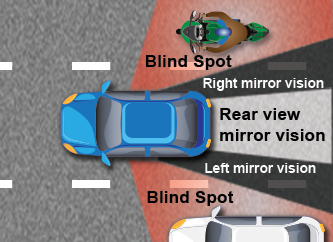
Before you change lanes:
- Use your turn signal to let other drivers know you plan to change lanes.
- Check your side and rearview mirrors for traffic approaching from behind.
- Glance over your shoulder in the direction you are moving to check your blind spot.
Space Cushion, Curves & Changing Lanes: Knowledge Check
5 questions. Answer them all, then check your answers. You can change your answers and try again as many times as you want.
1. A safe following distance is:
2. To check your following distance, you should count the seconds it takes you to reach a fixed point after:
3. Which of these increases your stopping distance?
4. A blind spot is:
5. Before changing lanes, you should: